When should I not build eCommerce in Laravel?
You should not build an eCommerce system in Laravel when the business needs a mature, ready-made commerce platform. Laravel is a web application framework, not a complete eCommerce product. Choosing it means your team owns the entire commerce domain: the product model, pricing rules, order lifecycle, and everything else a platform like Shopify, Magento, or Shopware already ships with.
Quick Answer
Laravel is the wrong starting point when you need to launch quickly, have conventional catalog and checkout requirements, or have a small team with limited capacity to maintain custom code. It’s also the wrong starting point when PCI compliance and payment processing need to be the platform’s responsibility, not yours. In these cases, an established platform gets you further, faster, with less ongoing liability than building the same functionality from scratch.
When Laravel is probably not the right choice for eCommerce
1. You need a standard online store quickly
If the requirement is essentially a conventional store with products, categories, variants, cart, checkout, customer accounts, orders, discounts, shipping, and payment integrations, building all of it directly in Laravel recreates work a platform has already solved. Laravel gives you the application framework and building blocks, not a ready-to-configure eCommerce domain. Your team still has to design the product model, pricing rules, inventory behavior, and order lifecycle from nothing.
2. Your requirements closely match an existing platform
A standard B2C catalog and checkout with common payment, shipping, tax, and promotional features is a configuration problem, not an application development problem. Shopify, Magento, and Shopware already cover this ground. Building that same layer in Laravel increases the custom code your team has to test, secure, document, and maintain, without adding business value that justifies the cost.
3. You don’t have the engineering capacity to maintain it
A custom Laravel commerce build isn’t finished when the first checkout works. Your team owns the business rules, integrations, database schema, background jobs, admin tooling, and security patching for as long as the store runs. Laravel gives you real infrastructure for parts of this: its queue system moves slow work into background jobs, and Horizon manages and monitors Redis-backed queues (see the queues documentation). That’s engineering infrastructure, not prebuilt commerce functionality. A platform vendor patches security issues and ships updates without you assigning anyone to it. Without an in-house developer or ongoing budget past launch day, custom code becomes a liability within a year or two as dependencies age.
4. Payment compliance needs to sit with the platform
Handling card data directly pulls PCI DSS scope onto your own infrastructure. Hosted platforms absorb most of that scope by keeping checkout and payment processing on their side. You can build custom payment handling in Laravel, but it means owning compliance work a platform would otherwise carry for you. That’s rarely worth it unless payment logic itself is a core differentiator for the business.
5. The project is mostly configuration, not unique logic
Laravel earns its place when the application needs behavior that doesn’t fit an existing commerce platform. The reverse matters just as much. If most of the project is configuring standard catalog management, pricing, promotions, and order processing that Shopify, Magento, or Shopware already provide out of the box, a framework hands you more freedom than the project needs, and reimplementing solved problems expands scope without adding a matching return.
When Laravel is still the better choice
None of this means Laravel is unsuitable for eCommerce. It means Laravel is the wrong default for a store whose needs already fit a platform. Laravel becomes the stronger choice when the business model itself is the reason the application has to be custom:
- Highly custom pricing: prices depend on business rules that don’t map cleanly to any existing platform.
- Non-standard checkout: the purchase process is substantially different from a conventional cart-and-checkout flow.
- Complex workflows: orders pass through business-specific approval, fulfilment, or operational steps.
- Custom integrations: the application coordinates several internal or external systems in ways no platform handles cleanly.
- Commerce is part of a larger application: purchasing is one component of a broader system, not the whole product.
- Full control matters: the team needs control over the domain model, architecture, and deployment that a platform would restrict.
That’s a different decision with a different answer, covered in when to build custom in Laravel instead of extending a platform. If your project fits one of these situations, our team builds custom Laravel commerce applications for exactly this kind of scenario.
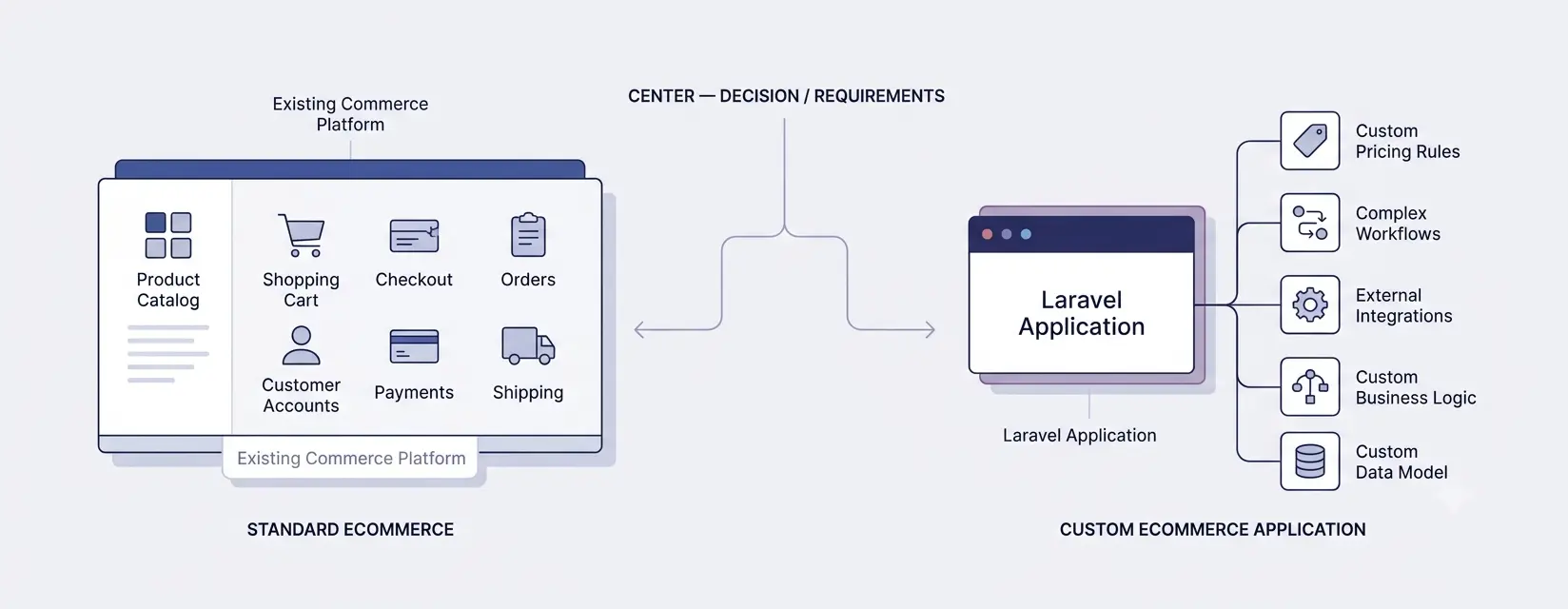
Laravel versus a commerce platform
The decision gets easier once you separate the framework from the commerce layer, whether that platform is Shopify, Magento, or Shopware.
| Requirement | Laravel from scratch | Existing commerce platform |
|---|---|---|
| Highly custom business rules | Often a good fit | May require heavy customization |
| Standard store functionality | Requires substantial build work | Already available |
| Fast launch | Requires more upfront engineering | Usually faster |
| Architectural control | Strong advantage | Depends on the platform |
| Custom integrations and workflows | Strong fit for unusual requirements | Depends on extension capabilities |
| PCI compliance ownership | Falls on your team | Largely handled by the platform |
| Owning the application code | Yes | Depends on the platform |
Don’t reject Laravel on scalability alone
Future traffic by itself is not a good reason to rule out Laravel. It supports separate read and write database connections. Its cache layer works with Redis or Memcached, and its queue system supports Redis, Amazon SQS, or relational databases. The deployment documentation covers production commands for configuration, route, and view caching. These are real tools for scale, though the resulting architecture still depends on how you design the application around them.
The better question isn’t whether Laravel can handle eCommerce at scale. It’s whether building and owning this particular commerce system in Laravel makes sense for your business and the team that has to maintain it.
A practical decision rule
Be cautious about Laravel when the project is mostly a conventional store and the main reason for choosing it is that the team already knows PHP. Consider an existing platform first when the business needs standard commerce capabilities and wants a shorter path to launch. Consider Laravel when the application’s value comes from custom business logic, unusual workflows, or integrations that would make Shopify, Magento, or Shopware difficult to adapt.
The strongest reason not to build eCommerce in Laravel isn’t that Laravel can’t do it. It’s that building and maintaining a complete commerce system yourself is unnecessary work when your requirements already fit an existing platform. If you’re not sure which side of that line your project falls on, map your actual requirements against what a platform already does before writing any custom code. That exercise usually settles the question on its own.
Related Answers
 What does a Laravel service layer around an existing system actually look like?
How do I decide between custom Laravel middleware and an off-the-shelf integration platform?
Should integration logic live inside the store or in a separate Laravel service?
Should I build my SaaS multi-tenant from day one?
What does a Laravel service layer around an existing system actually look like?
How do I decide between custom Laravel middleware and an off-the-shelf integration platform?
Should integration logic live inside the store or in a separate Laravel service?
Should I build my SaaS multi-tenant from day one? Still need help?
Not sure if Laravel or a platform is the right fit?
Tell us what your store actually needs to do. We'll tell you honestly whether that's a Laravel project or something a platform like Shopify or Magento already handles.