When should I build a SaaS product on Laravel rather than another stack?
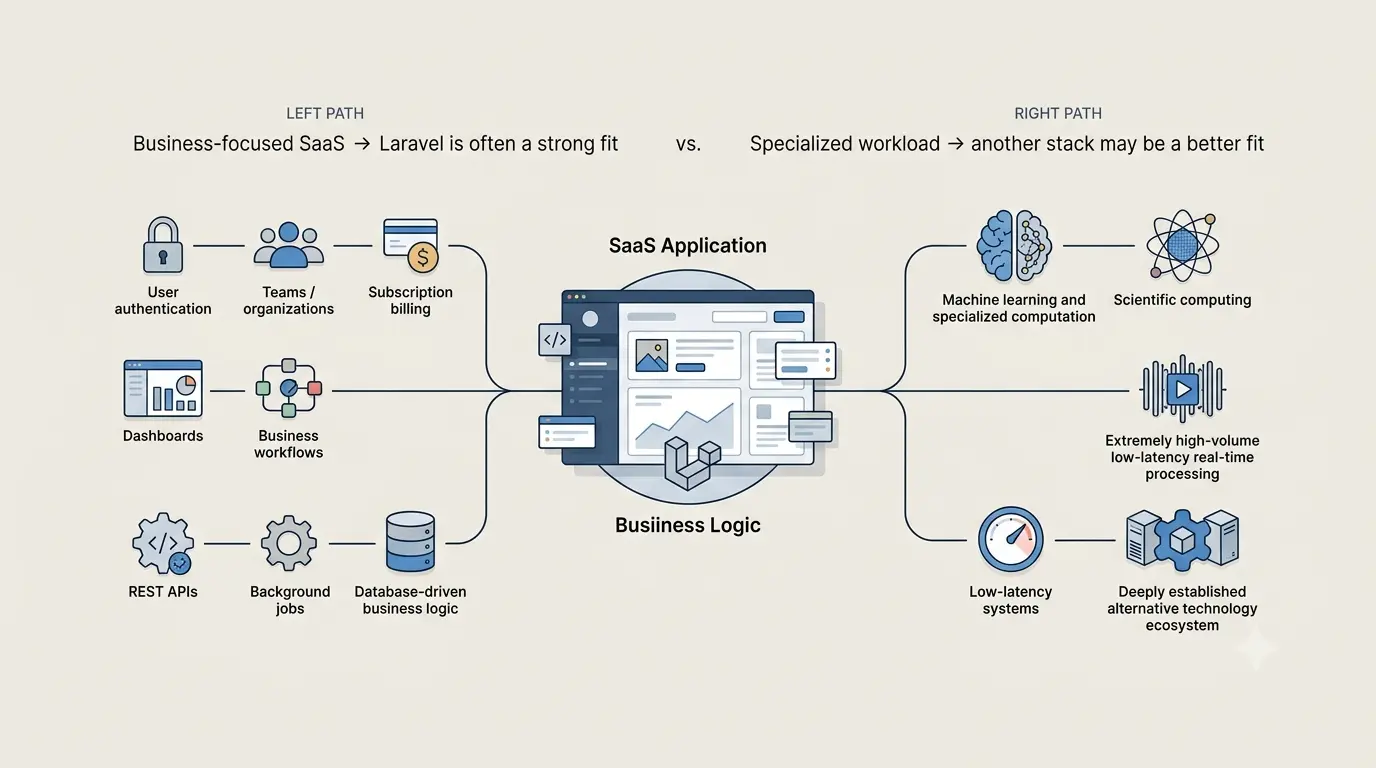
Build a SaaS product on Laravel when it’s fundamentally a business application. That means user accounts, teams, subscription billing, dashboards, workflows, and background jobs. Laravel ships official packages for most of this, so you’re not assembling a backend from scratch. Pick another stack when your core workload sits outside that shape. That includes specialized computation, extreme real-time concurrency, or a team already deep in another ecosystem.
Quick Answer
Choose Laravel when the SaaS is mostly business logic, workflows, and API access, especially with a PHP-strong team. Cashier handles Stripe or Paddle billing, Sanctum handles API and SPA authentication, and built-in queues handle background jobs. Consider another stack when the core workload fits a different ecosystem better. Examples include a data-science product, a specialized real-time system, or a team already standardized elsewhere.
When Laravel is the stronger choice
A typical SaaS needs more than request handling. It needs authentication, authorization, validation, billing, queues, notifications, and an API. Laravel provides framework-level support and official packages for most of this. That fits products where complexity lives in business rules, not specialized computation.
- Users belong to organizations or teams, with different roles doing different things.
- Records move through workflows and states. Customers have plans, limits, or entitlements.
- The product needs subscription billing. Cashier integrates Stripe or Paddle, though you still own the entitlement model and webhook handling.
- Background jobs handle imports, exports, or integrations. Laravel’s queue API supports Redis, Amazon SQS, and database queues, with Horizon for Redis monitoring.
- The team is productive in PHP, or the frontend prefers React or Vue. Laravel works as a full-stack framework or as an API backend, with Sanctum handling authentication either way.
This is where custom Laravel development earns its place, instead of a backend stitched from separate frameworks.
When another stack is the stronger choice
- The core workload depends heavily on a specialized ecosystem, like ML libraries or scientific computing. Another language may be substantially stronger for that specific work.
- The organization already has mature infrastructure, tooling, and experienced developers around another stack. Existing expertise is a legitimate architectural constraint, not just a preference.
- Extremely high-volume, low-latency real-time processing is the product’s defining feature, not a supporting one. Ordinary dashboard notifications don’t disqualify Laravel on their own. A trading engine or live-collaboration core likely does.
How Laravel fits common SaaS situations
| Situation | Laravel fit | What to evaluate |
|---|---|---|
| Database-driven B2B SaaS | Strong | Business rules, auth, and billing are natural Laravel workloads. |
| API-first SaaS with a separate frontend | Strong | Sanctum covers SPA and token authentication for a decoupled frontend. |
| Queue-heavy SaaS | Strong | Redis, SQS, and database queue backends are supported natively. |
| Compute-intensive scientific or ML product | Depends | Whether the required libraries and runtime are meaningfully stronger elsewhere. |
| Extremely specialized real-time system | Depends | Latency, throughput, and concurrency model the core product needs. |
| Organization already standardized elsewhere | Depends | Cost of a new language and toolchain against what Laravel saves. |
What Laravel doesn’t decide for you
Laravel doesn’t settle your tenancy model, authorization design, or PHP version policy. Treating it like it does causes problems later.
You still decide whether tenants share a database, use separate schemas, or use separate databases. Then you enforce that isolation everywhere. You still design authorization for organization roles, resource permissions, and billing admins separately from authentication.
Pick a supported PHP version deliberately too. As of September 2026, PHP 8.4 and 8.5 are actively supported. PHP 8.3 and 8.2 are security-only, and PHP 8.2 reaches end of life on December 31, 2026. A new project should target 8.4 or 8.5, not an aging default.
Framework speed isn’t a good reason to reject Laravel, and it isn’t a good reason to choose it either. Database design, query efficiency, and caching strategy affect performance more than the framework choice. Octane exists for apps that need a long-running server later. It adds memory and state considerations, so adopt it because measurements justify it, not by default.
Make the call from what your product’s workload actually looks like. Authentication, billing, and workflow logic point toward Laravel. A specialized computational core, an extreme real-time requirement, or deep investment in another stack point away from it. This is a decision worth making once, deliberately, not revisited every time a new framework trends.
Related Answers
 What does a Laravel service layer around an existing system actually look like?
How do I decide between custom Laravel middleware and an off-the-shelf integration platform?
Should integration logic live inside the store or in a separate Laravel service?
Should I build my SaaS multi-tenant from day one?
What does a Laravel service layer around an existing system actually look like?
How do I decide between custom Laravel middleware and an off-the-shelf integration platform?
Should integration logic live inside the store or in a separate Laravel service?
Should I build my SaaS multi-tenant from day one? Still need help?
Not sure if Laravel is the right stack for your SaaS?
If you're weighing Laravel against another framework for a real product, we'll look at your actual workload and give you a straight answer, not a sales pitch.