Is your Magento store fast enough?
It’s a simple question, but the answer can be uncomfortable. Page speed has a measurable, well-documented effect on conversion, and “fast enough” is a constantly moving target. You’ve optimized images, enabled caching, and streamlined your checkout, but you still feel like you’re driving with the handbrake on. Your mobile experience feels clunky, bounce rates are stubbornly high, and every front-end update requires a monumental effort from your development team.
If this sounds familiar, you’re not alone. You’ve hit the ceiling of traditional, monolithic e-commerce architecture.
But what if you could break through that ceiling? What if you could deliver an app-like, sub-second mobile experience, achieve unparalleled creative freedom, and see your conversion rates climb to new heights? The solution is already here, and it’s a powerful combination: Headless Commerce & PWA in Magento.
This guide breaks down what headless commerce and PWA actually mean for a Magento store, when the switch is worth the added complexity, and what the implementation process looks like in practice.
The Traditional Magento Dilemma: Why Monolithic Architecture Holds You Back
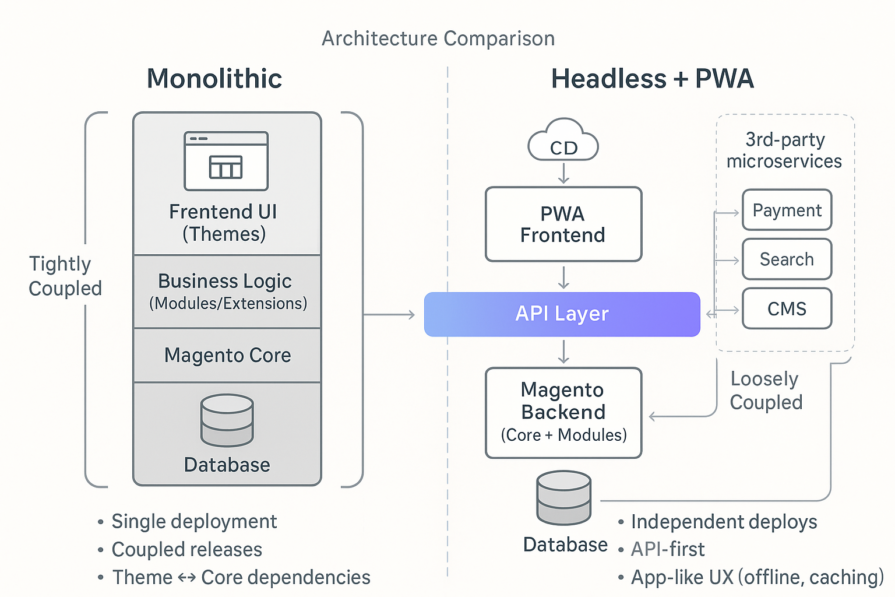
For years, Magento has been a powerhouse, but its traditional, “monolithic” architecture comes with inherent limitations. In a monolith, the front-end (the “head,” or what your customers see and interact with) and the back-end (the commerce engine, databases, and business logic) are tightly interwoven into a single, massive codebase.
Think of it like a pre-fabricated house. While sturdy and reliable, changing anything significant—like moving a wall or redesigning the kitchen—requires a major, complex overhaul that risks destabilizing the entire structure.
This tight coupling leads to several critical business challenges:
- Sluggish Performance: The heavy, complex front-end theme layer slows down page loads, especially on mobile devices. This directly impacts your SEO rankings and frustrates users.
- Poor Mobile Experience: Creating a truly seamless, app-like mobile experience on a traditional Magento theme is incredibly difficult and costly. The result is often a compromised, slow, and frustrating user journey.
- Limited Flexibility: Customizing the user experience is complex. Developers have to work within the rigid constraints of Magento’s theme structure, stifling innovation and slowing down time-to-market for new features.
- Update Paralysis: A simple front-end update can have unintended consequences for the back-end, making development cycles slow, risky, and expensive.
Because of this, merchants often find themselves spending more time fighting their platform than delighting their customers.
The Solution Unveiled: Understanding Headless Commerce & PWA in Magento
To break free from these limitations, we need to separate the front-end from the back-end. This is the core principle behind the powerful duo of Headless Commerce and Progressive Web App (PWA).
What is Headless Commerce in the Magento Context?
Headless commerce “decouples” the front-end presentation layer from the back-end Magento commerce engine.
- The Back-End (Magento): Continues to do what it does best—manage products, inventory, orders, customer data, and promotions.
- The Front-End (The “Head”): Becomes a completely separate application, built with modern, high-performance technology.
The two systems communicate through APIs, which handle requests and data transfer between the back-end and the front-end. This separation means your front-end isn’t constrained by Magento’s native theme structure, though it does mean you’re now maintaining and versioning two connected systems instead of one.
What is Progressive Web App (PWA)?
A Progressive Web App is a website built to deliver the speed and feel of a native mobile app, directly in a browser, without requiring an app store install. PWA is built to be:
- Fast: They load quickly and stay responsive even on slower network connections.
- Reliable: PWA can work offline, allowing customers to browse products even without an internet connection.
- Engaging: They enable features like push notifications to re-engage customers with abandoned carts or special offers.
- Installable: Users can add your store to their phone’s home screen with a single tap, creating a permanent brand presence without needing an app store.
How Headless and PWA Work Together
When you combine these two concepts, you get the ultimate e-commerce solution. Headless Commerce & PWA in Magento means using the decoupled headless architecture to power a lightning-fast PWA front-end.
Magento still handles catalog, checkout logic, and order management. Headless just means the storefront isn’t forced to render through Magento’s own templating, so a team can build the front end in whatever stack fits the project, with the trade-off of an added integration layer to maintain.
The Tangible Benefits: How Headless Commerce & PWA in Magento Drive Growth
Adopting this modern architecture isn’t just a technical upgrade; it’s a strategic business decision that delivers measurable results across the board.
1. Blazing-Fast Performance & Core Web Vitals Mastery
This is the most immediate and impactful benefit. PWA front-ends are built on modern JavaScript frameworks (like React or Vue.js) that are optimized for speed. Consequently, you can achieve sub-second load times, which is critical for both user experience and SEO. Google’s Core Web Vitals are now a key ranking factor, and a headless PWA is one effective way to score well on these metrics, boosting your organic visibility. We’ve seen this play out directly: our Magento Performance Optimization case study walks through how we took an Adobe Commerce store to 3x faster load times, the same kind of gains this section is describing.
2. More Design Flexibility and Omnichannel Reach
With the front-end decoupled, your design and development teams are free to create truly unique and immersive user experiences. You’re no longer confined to a Magento template. Furthermore, a headless back-end can deliver content and commerce functionality to any front-end—not just your website. This includes:
- Mobile apps
- In-store kiosks
- IoT devices (like smart mirrors)
- Content management systems (CMS)
This is true omnichannel commerce, managed from a single, centralized Magento back-end.
3. Better Conversion Rates and Lower Bounce Rates
Speed directly translates to revenue. A faster, more intuitive user experience keeps customers engaged and dramatically reduces bounce rates. According to data from Statista, mobile commerce is booming, but conversion rates on mobile still lag behind desktop. A PWA closes this gap by providing a superior, app-like experience that makes browsing and buying on a smartphone effortless and enjoyable.
| Metric | Traditional Magento Theme | Headless PWA on Magento |
|---|---|---|
| Typical Load Time | 3–5+ seconds | Under 1 second, achievable with a well-built PWA |
| Mobile Conversion Rate | Often below desktop conversion rates | Can close much of the mobile-vs-desktop gap |
| Bounce Rate | Higher, especially on mobile | Typically lower with faster load times |
| Development Flexibility | Constrained by Magento’s theme structure | Front-end and back-end teams can work independently |
These are typical, directional differences based on the projects we’ve worked on, not measured benchmarks from a specific study. Actual results depend heavily on implementation quality on both sides.
Not sure if these numbers apply to your store?
Every Magento setup is different. Tell us where your store is slow and we’ll tell you honestly whether headless is the fix, or whether something simpler gets you there.
Get a quick assessment →4. Enhanced Developer Agility & Faster Time-to-Market
In a headless setup, your front-end and back-end teams can work independently and simultaneously. While the back-end team manages the Magento infrastructure, the front-end team can rapidly build, test, and deploy new features and user interfaces using modern, efficient workflows. This agility allows you to innovate faster and respond to market changes more quickly than your monolithic competitors.
Implementing Headless Commerce & PWA in Magento: Your Strategic Roadmap
Transitioning to a headless PWA is a significant project, but with a clear strategy, it’s a manageable and highly rewarding one. Here’s a simplified overview of the process.
Step 1: Choosing Your Headless Front-End Framework
You don’t have to build a PWA from scratch. Several frameworks are designed to work with Magento, though it’s worth knowing where each one sits in 2026:
- Adobe PWA Studio: Magento’s official toolkit for building PWA, well-integrated with Adobe Commerce. Adobe moved it to maintenance mode in 2024: it still receives security patches and compatibility updates, but no active feature development, and Adobe is steering new projects toward Edge Delivery Services instead.
- Vue Storefront (Alokai): A platform-agnostic framework known for its flexibility and strong community support.
- Custom Build: For ultimate control, you can build a custom front-end using frameworks like React, Vue.js, or Next.js.
It’s also worth asking whether you need to go fully headless at all. Hyvä takes a different approach: it replaces Magento’s front-end layer with a fast, lightweight theme built on Tailwind CSS, without decoupling the storefront into a separate application. For stores that mainly need speed and don’t need the front end running on multiple channels (mobile app, IoT, kiosks), Hyvä often gets you most of the performance benefit with a lot less architectural complexity to maintain.
Step 2: Leveraging Magento’s APIs
The communication between your new front-end and Magento’s back-end will happen via APIs. Magento offers robust support for both GraphQL and REST APIs, with GraphQL being the preferred modern choice for its efficiency in fetching complex data for front-end applications.
Step 3: Planning the Migration & Development
A successful transition requires careful planning. Key considerations include:
- Feature Parity: Ensuring all your current features and third-party integrations will work with the new front-end.
- SEO Migration: Developing a comprehensive SEO strategy to ensure you retain and improve your rankings during the switch.
- Team Expertise: Partnering with an agency that has proven expertise in Headless Commerce & PWA in Magento is crucial for a smooth and successful project.
FAQs about Headless Commerce and PWA in Magento
Is headless commerce worth it for a small Magento store?
How much does a Magento PWA cost?
PWA Studio vs Hyvä: which should I choose?
Do I lose SEO rankings when switching to headless?
Ready to Unlock Peak Performance with Headless Commerce & PWA in Magento?
A monolithic architecture isn’t wrong for every store, plenty of Magento stores run well on Hyvä without going headless at all. But if you’re already hitting real limits on mobile performance, front-end flexibility, or omnichannel reach, headless with a PWA front end is a proven path forward, with the added engineering overhead that comes with running two connected systems instead of one.
If you’re weighing whether headless is worth it for your store, talk to our Magento team. We’ll look at your current setup and tell you honestly whether headless makes sense, or whether a simpler fix gets you most of the way there.