Just a year or two ago, “AI” felt more like a buzzword than a practical tool for many eCommerce leaders. That’s changing—fast. We’ve moved beyond simple chatbots to something far more impactful: Shopify AI agents. These are not just add-ons; they are becoming a core component of a modern, intelligent, and hyper-efficient eCommerce operation.
As a CTO or Head of eCommerce, your focus is likely on driving revenue and increasing operational efficiency. You’re asking how to personalize customer journeys at scale, automate tedious back-office tasks, and get ahead of inventory issues before they hurt your bottom line. This is precisely where Shopify AI agents are making a tangible difference.
This guide breaks down exactly what these agents are, how they work, and provides a clear, strategic framework for integrating them into your Shopify Plus store. We’ll explore real-world use cases that go far beyond basic customer support, from intelligent inventory management to proactive fraud detection, giving you a roadmap to unlock the next level of eCommerce performance. We’ve also updated this guide to cover Shopify’s own native AI layer, since the platform has moved fast on this front and it changes what “adding an AI agent” actually means for your store.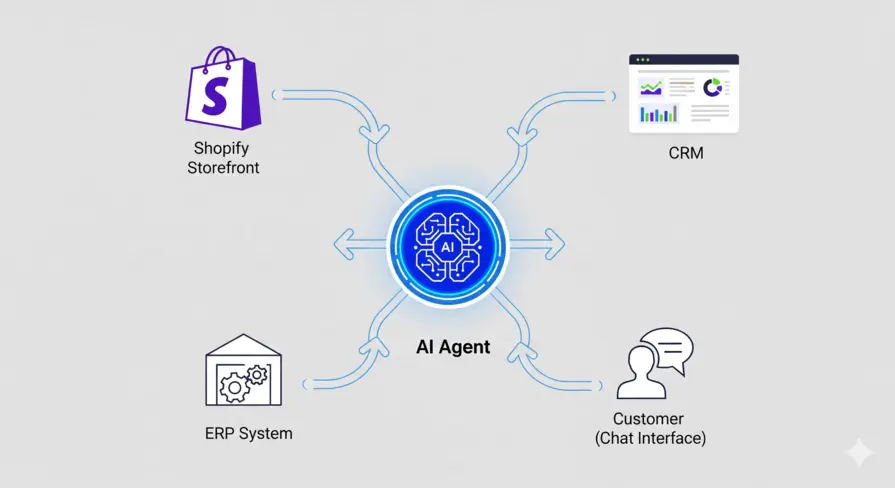
What Exactly Are Shopify AI Agents (and What They Aren’t)?
First, let’s clear up the confusion. A Shopify AI agent is not just a standard chatbot. While a chatbot follows a rigid, pre-programmed script to answer common questions, an AI agent is a more autonomous and intelligent system designed to take action.
In practice: Think of an AI agent as a digital employee that can analyze data, make decisions, and execute tasks within your Shopify environment.
Here’s the key distinction:
- A chatbot is a conversational FAQ document. It can only respond with information it has been explicitly given.
- An AI agent, on the other hand, can access your store’s live data, analyze it, make decisions, and even perform actions on its own within predefined parameters. It learns from interactions and can handle complex, multi-step processes.
These agents are powered by Large Language Models (LLMs) and integrate directly with your store’s data—products, customers, orders, and inventory. This deep connection, as highlighted by Shopify’s own push into intelligent automation, allows them to perform tasks that were once exclusively manual.
The Three Core Pillars of Shopify AI Agents
Shopify AI agents typically operate across three key areas of an eCommerce business. Each pillar builds on the last to create a cohesive, intelligent system that drives growth and efficiency.
| Pillar | Core Function | Example Use Cases | Business Impact |
|---|---|---|---|
| 1. Customer Experience | Personalize and automate 24/7 customer interactions. | Proactive order status updates, personalized product recommendations, real-time query resolution. | Increased customer satisfaction (CSAT), higher conversion rates, and reduced support ticket volume. |
| 2. Operations & Inventory | Automate and optimize back-office processes. | Predictive inventory forecasting, automated reordering workflows, intelligent fraud analysis. | Fewer stockouts, lower operational costs, and minimized revenue loss from fraud. |
| 3. Marketing & Merchandising | Drive data-informed marketing and product strategies. | Automated customer segmentation, dynamic pricing adjustments, AI-generated product descriptions. | Higher marketing ROI, improved Average Order Value (AOV), and faster time-to-market. |
For businesses in the US, EU, and especially the DACH region, the ability of these agents to handle multilingual support and adhere to GDPR principles for data handling is a significant advantage. A properly configured agent ensures that customer data is processed according to strict privacy regulations, a crucial consideration we address in our custom eCommerce development projects.
Shopify’s Own AI Layer: Sidekick, Agentic Storefronts, and What They Mean for You
So far we’ve talked about AI agents as something you add to your store, usually a third-party app or a custom build. But Shopify itself has built a native AI layer directly into the platform, and it’s worth understanding what that covers before you decide where a custom agent is actually needed.
| Layer | Who It’s For | What It Does |
|---|---|---|
| Sidekick | Merchants | Handles admin tasks in plain language: segmentation, pricing changes, discounts. Every change still needs merchant approval before it goes live. |
| Agentic Storefronts | Customers | Makes your catalog discoverable and purchasable directly inside AI chat platforms like ChatGPT, Microsoft Copilot, and Google AI Mode. |
| Storefront MCP + Agentic Checkout | AI agents themselves | The infrastructure that lets an AI agent search your catalog, check real inventory, build a cart, and complete payment. |
These are all native to Shopify. The custom agents covered throughout this guide sit on top of this layer, not instead of it.
Where Native Tools End and Custom Development Begins
What makes this worth understanding before you build anything custom is the approval model. Sidekick never pushes a change to your live store without you signing off first, so a merchant stays in the loop on pricing, segmentation, or discount changes even though the AI is doing the work. Agentic Storefronts and Storefront MCP operate a level below that, they’re what make your catalog visible and transactable to an outside AI agent in the first place, which matters even if you never touch Sidekick directly.
Shopify has reported that AI-driven traffic to its stores grew sharply through the first half of 2026, with a notable jump in orders coming from AI-powered searches specifically. Those are Shopify’s own reported figures rather than independently audited numbers, but the direction is consistent with what we’re seeing across client stores: shoppers are starting more journeys inside an AI chat instead of a search bar.
Here’s the practical distinction that matters for your roadmap: Sidekick and Agentic Storefronts handle the baseline, getting your store visible and transactable inside AI channels. What they don’t do is the business-specific logic this guide covers elsewhere, things like the sizing-recommendation agent, the proactive delivery-issue agent, or an inventory agent that talks to your actual ERP. That’s still custom work, and it’s where a development partner earns its keep. Native and custom aren’t competing options, they work together, with Shopify’s layer handling discoverability and checkout while your custom agents handle the parts specific to how your business actually runs.
Here’s the practical distinction that matters for your roadmap: Sidekick and Agentic Storefronts handle the baseline, getting your store visible and transactable inside AI channels. What they don’t do is the business-specific logic this guide covers elsewhere, things like the sizing-recommendation agent, the proactive delivery-issue agent, or an inventory agent that talks to your actual ERP. That’s still custom work, and it’s where a development partner earns its keep. Native and custom aren’t competing options, they work together, with Shopify’s layer handling discoverability and checkout while your custom agents handle the parts specific to how your business actually runs.
Real-World Applications: From Theory to Practice
Let’s move beyond the abstract and look at how intelligent eCommerce automation is being implemented today. These examples show how agents solve real, costly problems.
In practice: The best AI agent implementations target specific, measurable friction points in the customer journey or your internal operations.
Use Case 1: The Proactive Customer Support Agent
Imagine a customer in Germany places an order. Instead of waiting for them to ask, “Wo ist meine Bestellung?” (Where is my order?), the AI agent acts first.
- Action: It monitors the shipping carrier’s API. The moment the package is out for delivery, it sends a proactive email or SMS to the customer in German.
- Problem Solving: If a delivery is delayed, the agent can automatically check the reason. If it’s a customs issue, it can provide the customer with the necessary tracking information to resolve it, all without human intervention.
- Result: This transforms customer support from a reactive cost center into a proactive, loyalty-building engine. This service level is crucial for building trust in markets like the DACH region, where consumers expect high reliability.
Use Case 2: The Intelligent Inventory Manager
Stockouts are silent revenue killers. An AI inventory agent helps you prevent them before they happen, moving from simple alerts to predictive commerce automation.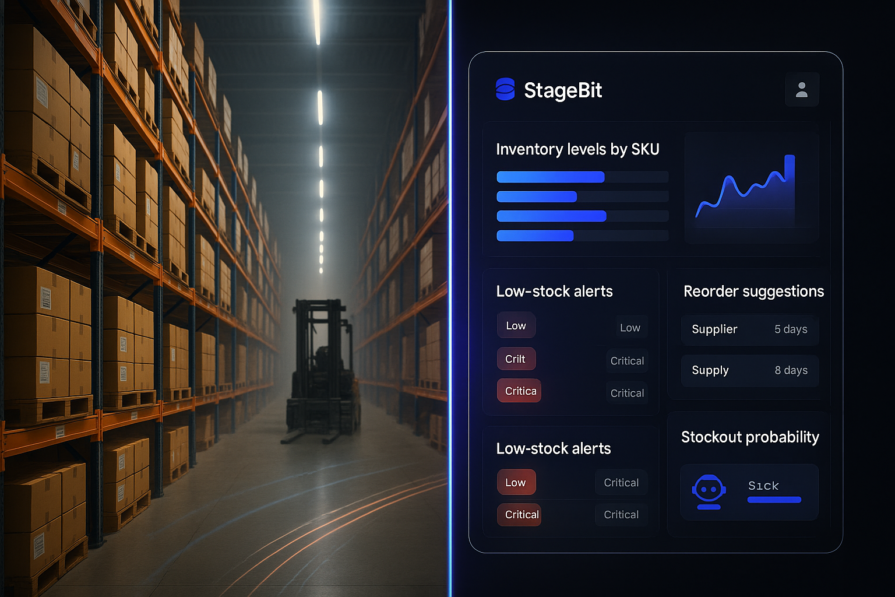
- Analysis: The agent analyzes historical sales data, seasonality, and current marketing campaigns. It sees you’re launching a promotion on a specific product next week.
- Prediction: Based on data from past promotions, it predicts a 150% spike in demand. It checks current stock levels and sees you’ll run out in three days if the promotion goes live.
- Action: It can automatically generate a draft purchase order for your approval or, if configured, place the order directly with your supplier. It can also adjust inventory levels across multi-location warehouses to meet regional demand
What This Looks Like in Practice: The Sizing Problem
Here’s a common pattern we see with fashion and apparel stores. A brand is struggling with a high return rate, especially on products with complex sizing. Customers frequently order the wrong size, and that turns into costly reverse logistics and frustrated buyers.
The fix isn’t a bigger size chart. It’s a Shopify AI agent on the product page that asks the customer a few quick questions, their height, weight, and preferred fit (“slim,” “regular,” “loose”), instead of leaving them to guess.
The agent compares that input against product specs and return data from similar customer profiles, then recommends a size. Done well, this kind of sizing agent can meaningfully cut size-related returns within a few months, since it’s catching the mismatch before the order ships instead of after the customer sends it back. It’s a clear example of AI solving a specific, measurable business problem rather than just being a feature for its own sake.
Seen enough to know you have a similar problem?
Tell us what’s costing you the most time or money right now, and we’ll tell you honestly whether an AI agent is the right fix or overkill.
Book a Free ConsultationHow to Strategically Implement Shopify AI Agents
Adopting this technology requires a clear strategy, not a scattered approach. Simply turning on a few AI apps won’t deliver transformative results.
In practice: A successful AI strategy starts with a single, well-defined problem and expands from there, proving its value at each step.
Your 6-Step AI Agent Rollout Checklist
The Future is Autonomous: Are You Ready?
Shopify AI agents are fundamentally changing the operational model for eCommerce businesses. They enable a level of personalization, efficiency, and data-driven decision-making that was previously only available to the largest enterprise players. Research from firms like Statista consistently shows the growing investment in AI for retail to improve operational efficiency.
By automating repetitive tasks, you free up your team to focus on high-value activities like strategy, brand building, and complex problem-solving. This isn’t about replacing humans; it’s about augmenting their capabilities.
The journey starts with identifying the right opportunity. Whether it’s improving your customer experience, optimizing your supply chain, or boosting your marketing ROI, there’s a strategic application for AI in your business.
Ready to explore how Shopify AI agents can transform your eCommerce operations?
Our team of experts specializes in developing and implementing custom AI solutions for Shopify Plus merchants. We can help you identify the highest-impact opportunities and build a roadmap for successful integration.
Schedule a Free Consultation to discuss your specific business needs and discover how you can leverage AI to drive growth.
Frequently Asked Questions (FAQ)
What is the main difference between a Shopify chatbot and an AI agent?
Can Shopify AI agents handle multiple languages for international stores?
Is it difficult to integrate an AI agent with my Shopify store?
How can an AI agent help with conversion rate optimization (CRO)?
What is the cost associated with implementing Shopify AI agents?
Are Shopify’s Sidekick and Agentic Storefronts the same thing as a Shopify AI agent?
Can I build similar AI agents for a WooCommerce store, or is this Shopify-only?
Adobe Commerce Certified Developer at Stagebit, working across Magento 2, Hyvä, Shopware 6, Shopify Plus, and Laravel projects.